Insights
Apr 18, 2026
In commercial banking, most institutions believe they have an operational problem to solve.
In reality, they have a relationship problem.
Covenant tracking, document collection, and ongoing compliance are still managed through a patchwork of emails, spreadsheets, and disconnected systems. Multiple bankers and credit team members reach out to the same client at different points in the process. Requests are repeated. Instructions are unclear. Follow-ups are reactive.
From the bank’s perspective, it feels like process inefficiency.
From the client’s perspective, it feels disjointed—and it shapes how they view the relationship.
And that distinction matters more than most banks realize. Industry research shows that client experience is now a primary competitive battleground in commercial banking, with leading banks shifting investment toward digital client engagement and relationship quality as key drivers of growth.
The Hidden Cost of Friction: Eroding the Relationship
Commercial clients rarely “abandon” a loan process.
They do something more consequential.
They shift business.
Most middle-market and commercial clients maintain multiple banking relationships. They choose where to deepen those relationships based not just on pricing or credit availability—but on how easy it is to do business.
There is a simple truth in banking:
Pricing matters most in the absence of value.
And “value,” from the client’s perspective, is largely defined by the quality of the relationship and the experience that supports it.
When document requests come through scattered emails…
When multiple people from the bank ask for the same information…
When there is no clear view of what is required or when it is due…
The bank begins to feel transactional.
Even if the underlying relationship is strong, the experience undermines it.
Where the Experience Breaks Down
The biggest point of friction is almost always document collection and covenant management.
Today, it typically looks like this:
Requests sent via email, often with limited context
Multiple back-and-forth exchanges to clarify what is needed
Attachments lost in threads or submitted multiple times
Uncertainty around whether documents were received or accepted
Last-minute scrambles as deadlines approach
This fragmentation is not just anecdotal. Across banking, manual processes and disconnected systems are consistently cited as major drivers of inefficiency and client dissatisfaction, particularly in document-heavy workflows like credit and compliance.
Internally, this creates inefficiency.
Externally, it creates frustration—and more importantly, it creates doubt.
Clients begin to question whether the bank is organized, coordinated, and truly aligned around serving them well.
From Transactional to Relationship-Centered Banking
Improving this experience is not about incremental process improvement.
It is about reinforcing the relationship.
When the experience is seamless, coordinated, and transparent, the client feels something very different:
The bank is aligned internally
The bank respects the client’s time
The bank is easy to do business with
That is what builds loyalty.
That is what drives share of wallet.
And that is what ultimately reduces the importance of price as the primary differentiator.
A Different Model: One Experience, One Source of Truth
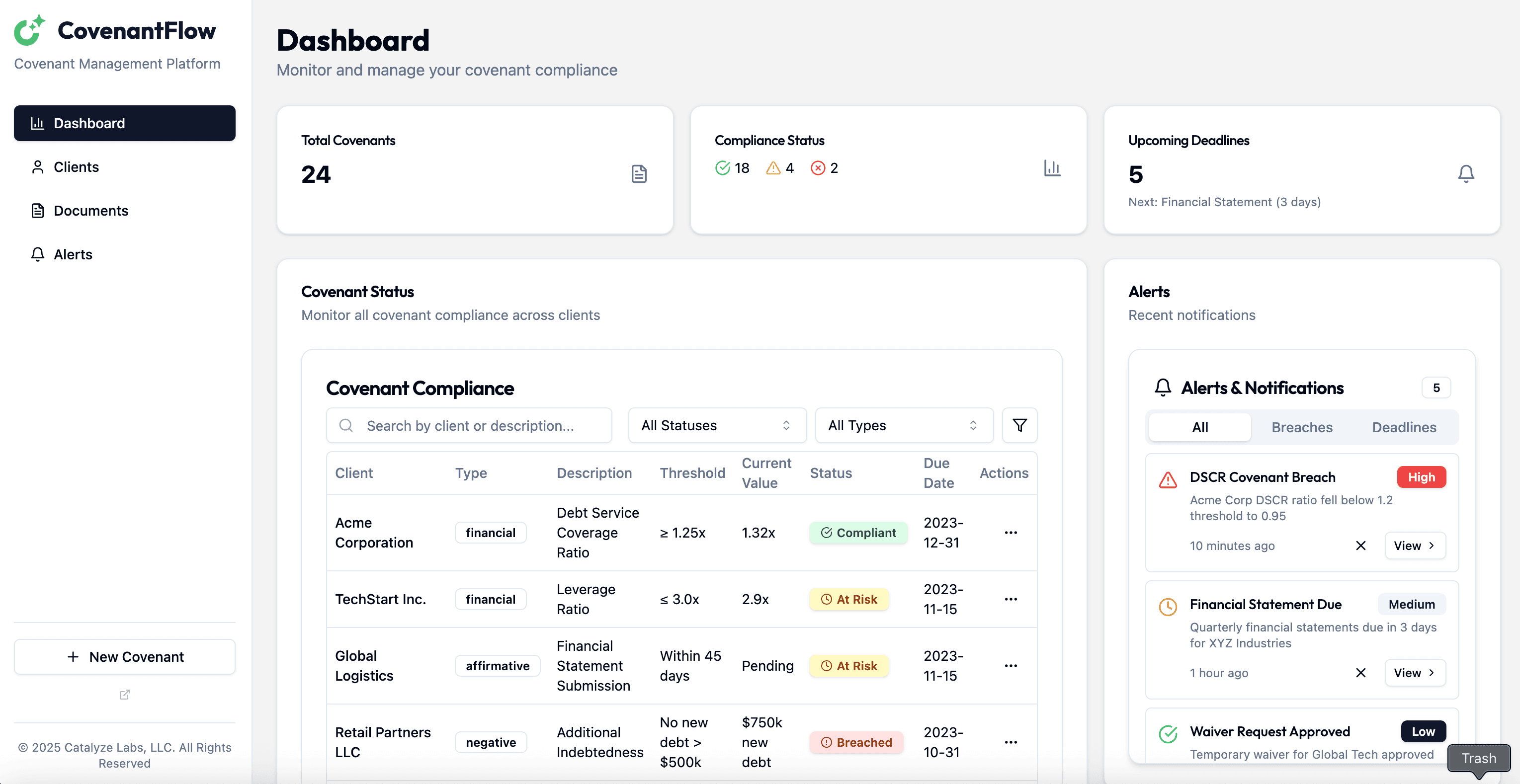
This is where a platform like CovenantFlow changes the dynamic.
Instead of layering technology on top of a fragmented process, it creates a single, structured experience for both the client and the bank.
At the center is a unified client portal that provides:
A full view of all active loans and associated obligations in one place
A clear view of all current and upcoming covenants
Specific document requirements tied directly to each obligation
Real-time visibility into submission status and approvals
Both the client and the bank operate from the same source of truth.
No duplicate requests.
No ambiguity.
No reliance on email as the system of record.
Just clarity.
And importantly, the experience extends beyond the portal itself.
By integrating with a client’s accounting and financial systems, CovenantFlow reduces the manual effort required to gather and submit information. Financials and supporting data can flow more directly into the covenant process, helping clients stay ahead of requirements rather than reacting to requests.
Instead of chasing information, clients are positioned to manage obligations proactively—with less effort and greater confidence.
Eliminating Friction Where It Matters Most
Document collection becomes simple and intuitive:
Clients upload documents directly into the platform
Files are automatically tied to the appropriate covenant
Both sides have immediate visibility into what has been submitted and what remains
What used to require multiple touchpoints becomes a single, clean interaction.
At the same time, internal coordination improves dramatically. Relationship managers, credit teams, and operations are all aligned around the same information—presented in a way that is easy to understand and act on.
The result is not just efficiency.
It is consistency in how the client experiences the bank.
From Reactive to Proactive Engagement
In most banks today, covenant management is reactive.
Requests go out. Deadlines approach. Urgency builds.
With a centralized, transparent system, the dynamic shifts.
Clients can see what is coming well in advance.
Reminders are timely and contextual.
Progress is visible at all times.
The interaction becomes proactive rather than reactive.
This shift aligns with broader industry trends, where commercial banks are investing heavily in real-time visibility and proactive client engagement as core differentiators.
And importantly, it feels coordinated—rather than fragmented—on the client side.
The Business Impact: More Than Efficiency
This is often framed as an operational improvement.
In practice, it is a growth and retention strategy.
Reducing friction in the client experience leads to:
Faster turnaround on financials and documentation
Lower operational overhead
Reduced risk of missed or delayed covenants
Stronger client engagement and satisfaction
But the most important impact is less tangible—and more valuable.
Clients choose to do more business with banks that are easy to work with.
They consolidate relationships where they feel understood and supported.
They are less sensitive to pricing when the experience consistently delivers value.
Beyond efficiency and risk reduction, there is a broader strategic benefit.
When a bank embeds itself into the client’s day-to-day financial workflows, integrating with accounting systems and reducing the effort required to manage obligations—it becomes more than a service provider.
It becomes part of how the client operates.
That level of integration increases consistency, strengthens engagement, and naturally deepens the relationship over time. The bank is no longer just where the loan resides—it is how the client manages it.
And that creates a different kind of loyalty.
Not one driven by pricing or convenience alone, but by the simple reality that the relationship works better.
A Shift Clients Notice Immediately
The most powerful change is not what happens inside the bank.
It is what the client feels.
They no longer wonder what is required.
They no longer search through email threads.
They no longer experience the bank as a series of disconnected interactions.
Instead, they engage with a bank that feels organized, transparent, and aligned.
That builds trust.
And in commercial banking, trust is what drives long-term relationships.
Conclusion
The future of covenant management is not just about making processes more efficient.
It is about strengthening the relationship between the bank and the client.
A single, coordinated experience.
A clear system of record.
A seamless way to manage obligations and documentation.
These are not just operational improvements.
They are signals to the client about who the bank is—and how much it values the relationship.
And in an increasingly competitive market, where clients have more choice and higher expectations, those signals are what ultimately determine where relationships grow—and where they don’t.
Because in the end, when value is clear, pricing matters less.
And the banks that understand that will be the ones that win.